
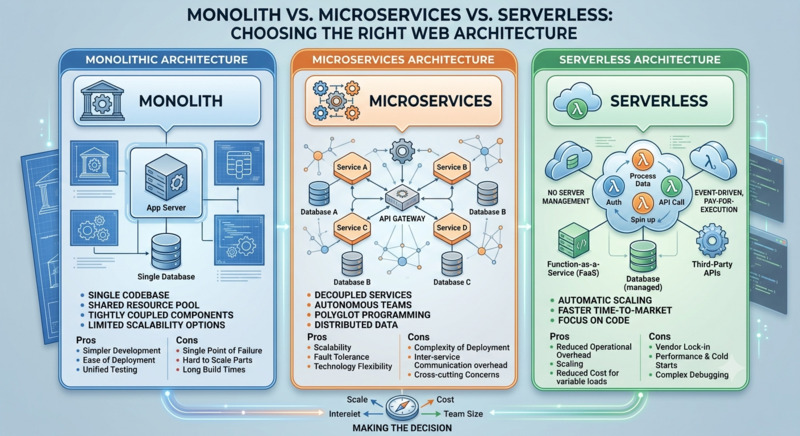
Building a modern web application isn't just about picking a design trend — it's about choosing an architectural foundation that supports long-term growth, speed, and cost efficiency.
When clients consult on new projects, the most frequent dilemma is: "Should we build a traditional monolithic application, transition to microservices, or go serverless?"
The short answer: there is no single "best" architecture, only the right fit for your business goals, team capacity, and infrastructure budget.
1. The Monolithic Architecture: Simple, Proven, and Fast to Market
A monolithic architecture combines the frontend, backend, database layer, and background processing into a single codebase and application server.
When to Use:
- Early-stage startups validating a Product-Market Fit (MVP).
- Applications where speed-to-market and low initial overhead are top priorities.
- Small to medium-sized teams requiring straightforward deployment pipelines.
Pros:
- Single codebase simplifies local development and testing.
- Direct memory calls between components, eliminating network latency.
- Straightforward deployment using traditional infrastructure or modern PaaS.
Cons:
- Tight coupling makes scaling individual bottleneck components difficult.
- Large codebases can become challenging to refactor over time.
2. Microservices: Decoupled for Massive Scale
Microservices break an application into independently deployable, modular services — each handling a distinct business responsibility and communicating over light protocols (like REST or gRPC).
When to Use:
- Established applications with distinct internal domains (e.g., payment routing, inventory management, analytics).
- Large engineering teams working on independent feature release cycles.
- Systems requiring differential scaling across components.
Pros:
- Independent deployment prevents a failure in one service from bringing down the entire platform.
- Polyglot development: teams can choose the best tech stack per service.
Cons:
- Increased operational complexity (requires robust CI/CD, tracing, and container orchestration).
- Higher infrastructure costs and latency overhead due to intra-service network calls.
3. Serverless & Edge Architectures: On-Demand Efficiency
Serverless architectures offload server management entirely. Functions run in short-lived containers on demand, often deployed directly to edge networks close to end users.
When to Use:
- Applications with unpredictable or highly bursty traffic patterns.
- Real-time API layers, webhooks, and asynchronous background jobs.
- Teams aiming to minimize idle server costs.
Pros:
- Automatic horizontal scaling with zero server administration.
- Pay-per-execution pricing model eliminates idle infrastructure expenses.
Cons:
- Potential cold-start latencies for infrequently accessed functions.
- Vendor lock-in risks depending on the cloud provider setup.
Architecture Comparison Matrix
| Feature | Monolith | Microservices | Serverless |
|---|---|---|---|
| Development Speed | High (Initial) | Medium | High |
| Operational Overhead | Low | High | Low |
| Scalability | Vertical | Horizontal | Automatic |
| Cost Model | Fixed Instance Costs | Fixed + Dynamic Instances | Pure Pay-Per-Use |
| Ideal Team Size | 1–5 Developers | 10+ Developers | 1–10 Developers |
Making the Decision: A Pragmatic Approach
If you are launching a new platform or validating a project concept, starting with a well-structured Monolith or a Modular Monolith is often the most cost-effective path. It delivers maximum velocity with minimal operational noise. As traffic demand and domain complexity scale, specific bottlenecks can be systematically refactored into independent services or serverless functions.